Showing posts with label industiral agriculture. Show all posts

Monday, October 18, 2010

Solving Africa's Hunger: Industrial Free, Small Ecological Farming Approach

For the first time, African farmers are being consulted to help solve one of the continent's greatest concerns.


Africa is hungry - 240 million people are undernourished. Now, for the first-time, small African farmers have been properly consulted on how to solve the problem of feeding sub-Saharan Africa. Their answers appear to directly repudiate a massive international effort to launch an African Green Revolution funded in large part by the Bill and Melinda Gates Foundation.
Instead of new hybrid seeds, chemical fertilisers and pesticides, family farmers in West Africa said they want to use local seeds, avoid spending precious cash on chemicals and most importantly to direct public agricultural research to meet their needs, according to a multi-media publication released on World Food Day (Oct. 16).


"There is a clear vision from these small farmers. They are rejecting the approach of the Alliance for a Green Revolution in Africa," said report co-author Michel Pimbert of the International Institute for Environment and Development (IIED), a non-profit research institute based in London.

"These were true farmer-led assessment where small farmers and other food producers listened and questioned agricultural and other experts and then came up with their own recommendations," Pimbert told IPS.

Serving the wrong master
"Food and agriculture policy and research tend to ignore the values, needs, knowledge and concerns of the very people who provide the food we all eat — and often serve instead powerful commercial interests such as multinational seed and food retailing companies," he said.
The United Nations Special Rapporteur on the Right to Food, Olivier De Schutter, backs the need for a fundamental shift in food and agricultural research to make it more democratic and accountable to society.

Wednesday, July 14, 2010

STOPPING MONSANTO

Dear Friend,
Although it was reported as a wholesale victory for Monsanto1, the recent Supreme Court decision on "Roundup Ready" alfalfa has actually put food activists in a good position to maintain the ban on Monsanto's genetically engineered GMO seeds.
The court ruled that the planting of GMO alfalfa is still illegal, but it assigned authority to the USDA to determine whether to allow some provisional planting to go forward as soon as next spring. The responsibility for maintaining a total ban on the GMO seeds — and protecting organic crops from likely contamination — falls squarely on the shoulders of USDA Secretary Tom Vilsack.
The court supported farmers' claims that the USDA illegally allowed Monsanto to sell its seeds before a full environmental review could be completed, but Monsanto knows that it can use its power within the USDA to speed up the review process. The company has already requested that the USDA permit a so-called "partial deregulation" that would allow some plantings of Roundup Ready alfalfa before we know the full risks.
A landmark element of the recent Supreme Court ruling was its recognition that the USDA must take into account economic harms from genetic contamination of conventional seed by genetically engineered seed — things like the loss of export markets or loss of organic certification, as well as the risks to the environment of this "gene flow" effect. Monsanto wants the agency to ignore those risks and let them plant now.
We can't let them. Senator Patrick Leahy and Congressman Peter DeFazio delivered a letter signed by over 50 lawmakers demanding that the USDA not legalize GE alfalfa.2 Over 83,000 Credo members added their voice by calling on their members of Congress to sign on to the letter.
Thank you for standing up for safe and healthy food.
Adam Klaus, Campaign Manager
CREDO Action from Working Assets

Sunday, July 4, 2010

Agroecology better than large scale industrial farming for global food security


By Raj on 06/23/2010 in Uncategorized
Olivier de Schutter, the UN Special Rapporteur on the Human Right to Food, is one of the most thorough thinkers I know. He doesn’t take a position until after he’s had a chance to run it by dozens of people, opponents and advocates (full disclosure: I’m one of the people who gets to see some of Olivier’s pre-publication thinking on economic matters), sifting through the evidence and arguments and arriving at a position that is unassailable. So it’s very pleasing to read his latest press release on the merits of agroecological farming. No doubt he’ll pay hell for the trouble he causes the proponents of Big Ag. But if he’s given the chance, he’ll argue them into a very tight corner. There’ll be a few follow-up documents from this meeting. When they’re released, you’ll find them on this site. Meantime:
Right to Food: “Agroecology outperforms large-scale industrial farming for global food security,” says UN expert
BRUSSELS (22 June 2010) – “Governments and international agencies urgently need to boost ecological farming techniques to increase food production and save the climate,” said UN Special Rapporteur on the Right to Food, Olivier De Schutter, while presenting the findings at an international meeting on agroecology held in Brussels on 21 and 22 June.

Thursday, June 24, 2010

Super-Weeds and Sub-Par Sollutions: The Case for More Labour in the Fields.

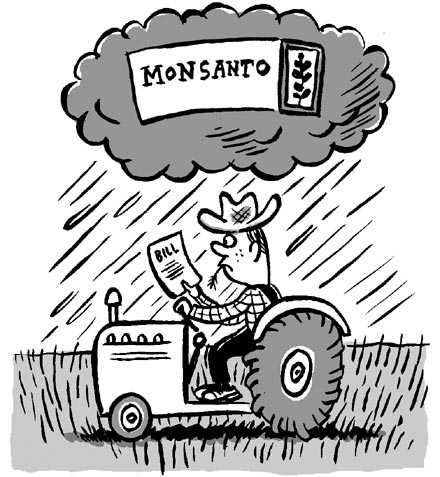
There has been a recent development within agriculture causing a bit of a stir: super-weeds. Super-weeds, "arewild plant that have become a virulent weed as a result of acquiring resistance to herbicides through pollination with a genetically modified plant". Much like the "use of of antibiotics contributed to the rise of drug-resistant super-germs", American farmers’ near-ubiquitous use of the weedkiller Roundup--a product of Monsanto Company--has led to the rapid growth of a tenacious new super-weeds. That become harder to kill-off and require an increasingly potent and increasing amount of pesticide. Now, many environmentalists and environmental groups have been warning about this development (which is more accurately described as a counter-to-development) since Monsanto Corporation's introduced the genetic modified roundup-ready-seeds and Roundup Herbicide in 1979 ( as well as Monsanto's AgentOrangein 1969 and rBGH in 1994).

The complaint from many farmers to the super-weeds is of economic concern, strong weeds means weaker crops and less money."To fight them, farmers throughout the East, Midwest and South are being forced to spray fields with more toxic herbicides, pull weeds by hand and return to more labor-intensive methods like regular plowing.“We’re back to where we were 20 years ago,” said Mr. Anderson, a farmer who will plow about one-third of his 3,000 acres of soybean fields this spring, more than he has in years. “We’re trying to find out what works.”

I am not sure if the "problem" is being properly defined. For one, perhaps it is not the super-weed that is the troubling factor, but rather industrial agriculture, as a total system failure. It is not sustainable, in most understandings of the concept, and any use of herbicide is a temporal solution. I am not sure what makes any chemical company think that the next line of more toxic herbicides and more genetically altered seeds will render a future without a subsequent generation of customized super-weeds? However, the lack of foresight and sustainability in this particular philosophy and practice of agriculture is not the purpose of this writing, nor is it the logic in creationing a solution that is very similar to the problem in the first hand. I feel these topics are fairly well laid out by people, much more articulate and informed than I, I also feel that a bit of  personal reflection and reading could convince someone of these points quite easily. Now that I have avoided "beating a dead horse", I wonder why more labour is a bad thing. For one the population of our earth is increasing, despite what Garrett Hardin concludes, we can sustain an earth population with some changes. But, with more people we may need more jobs, if we didn't use Chemical poisons to kills seeds and instead used, fair, labor in the fields that could be a solution, in a holistic sense, to two problems. And on top of the climate of today's recession economy, and the double digit unemployment rate, as high as 20% in some states, more labor many not be a bad things. Less environmental destruction, pollution and consumption and more work, more jobs and better standards of living (if done fairly, of course).

“The biotech industry is taking us into a more pesticide-dependent agriculture when they’ve always promised, and we need to be going in, the opposite direction,” said Bill Freese, a science policy analyst for the Center for Food Safety in Washington."
Monsanto, which once argued that resistance would not become a major problem, now cautions against exaggerating its impact. “It’s a serious issue, but it’s manageable,” said Rick Cole, who manages weed resistance issues in the United States for the company.

Tribute to Monsanto

Superweed Outbreak Triggers Arms Race

Hardy superweeds immune to the Farm Belt's most effective weedkiller are invading fields, prompting a counterattack from agribusiness that could leave farmers using greater amounts of harsh old-line herbicides.
The flagging weedkiller is Roundup. Its developer, Monsanto Co., also sells seeds for corn, soybean and cotton plants unaffected by the chemical, enabling farmers to spray it on freely without fear of harming their crops. Farmers now do so en masse, using "Roundup Ready" crop varieties for 90% of the soybeans and 80% of the corn grown across the U.S.

The rise of Roundup, more than a decade ago, sent older herbicides that damage both weeds and crops into deep eclipse. But now, as nasty invaders with names like pigweed, horseweed and Johnsongrass develop immunity to the mighty Roundup, chemical companies are dusting off the potent herbicides of old for an attack on the new superweeds.